
Learn everything about Betta fish, including care, tank setup, feeding, lifespan, behavior, diseases, and expert tips to keep your Betta healthy and thriving.
Introduction
Betta fish are among the most beautiful and popular freshwater aquarium fish in the world. Known for their vibrant colors, flowing fins, and unique personalities, they have become a favorite choice for both beginner and experienced fish keepers. Their intelligence, ability to recognize their owners, and fascinating behaviors make them much more than just decorative pets.
Native to the shallow waters of Southeast Asia, Betta fish have adapted to survive in environments where many other fish cannot. Thanks to their special labyrinth organ, they can breathe oxygen directly from the air, allowing them to thrive in low-oxygen habitats such as rice paddies, marshes, and slow-moving streams.
Despite their popularity, Betta fish are often misunderstood. Many people believe they can live happily in tiny bowls with little care, but the reality is quite different. Like any pet, Bettas require proper nutrition, clean water, the right tank setup, and a stable environment to live long, healthy lives.
In this complete guide, you’ll learn everything you need to know about Betta fish—from their history and natural habitat to tank setup, feeding, behavior, common diseases, breeding, and expert care tips. Whether you’re planning to buy your first Betta or looking to improve your fish-keeping skills, this guide will help you provide the best possible care.
Table of Contents
What Is a Betta Fish?
The Betta fish (Betta splendens), commonly known as the Siamese Fighting Fish, is a small tropical freshwater fish belonging to the family Osphronemidae. It is native to Thailand, Cambodia, Laos, and Vietnam, where it naturally inhabits slow-moving waters such as rice paddies, floodplains, canals, and marshes.
Bettas are best known for their dazzling colors, elegant fins, and territorial nature. While male Bettas are famous for their aggressive behavior toward other males, they are also highly intelligent and curious fish that interact with their surroundings in surprising ways. Many Betta owners observe their fish recognizing feeding times, following movement outside the aquarium, and even responding to their owner’s presence.
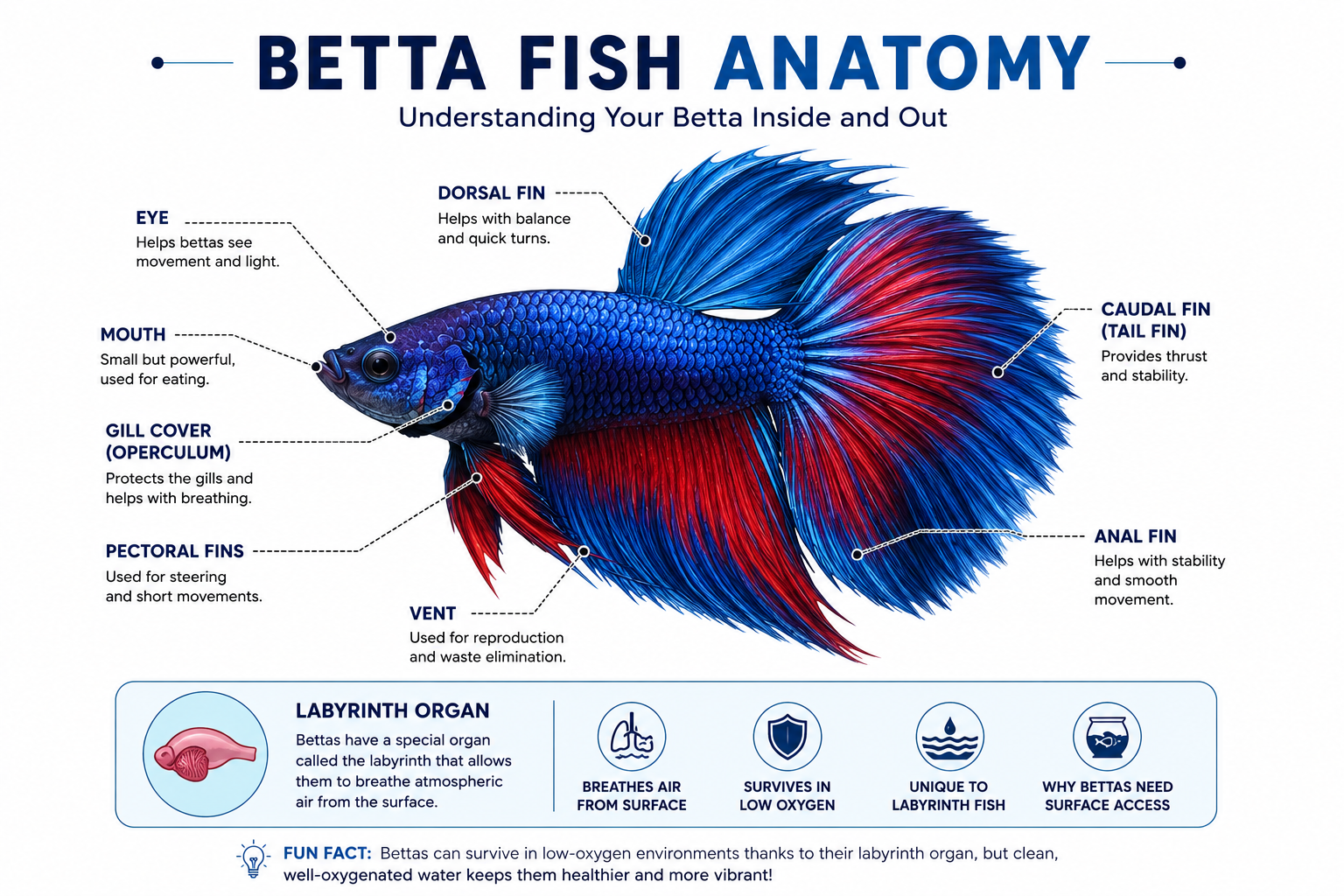
One of the most remarkable features of Betta fish is their labyrinth organ. This specialized breathing organ allows them to take oxygen directly from the air, enabling them to survive in oxygen-poor waters where many other fish would struggle. However, this adaptation does not mean Bettas should be kept in small bowls or poor water conditions. They still need a properly filtered, heated aquarium with regular maintenance to remain healthy.
Today, selective breeding has produced hundreds of stunning color variations and fin types, making Betta fish one of the most diverse and admired ornamental fish species in the aquarium hobby.
Betta Fish Quick Facts
If you’re new to keeping Betta fish, here’s a quick overview of their basic characteristics. This table gives you the most important information at a glance before diving into the detailed sections below.
| Feature | Details |
| Common Name | Betta Fish or Siamese Fighting Fish |
| Scientific Name | Betta splendens |
| Family | Osphronemidae |
| Origin | Thailand, Cambodia, Laos, and Vietnam |
| Natural Habitat | Rice paddies, marshes, canals, floodplains, and slow-moving streams |
| Average Size | 2.5–3 inches (6–7.5 cm) |
| Average Lifespan | 2–5 years with proper care |
| Temperament | Territorial, intelligent, and curious |
| Difficulty Level | Beginner-friendly |
| Diet | Carnivorous (high-protein diet) |
| Ideal Water Temperature | 78–80°F (25.5–26.5°C) |
| Recommended Tank Size | Minimum 5 gallons (19 liters) |
| Water pH | 6.8–7.5 |
| Compatibility | Best kept alone or with carefully selected peaceful tank mates |
| Unique Feature | Labyrinth organ allows breathing atmospheric oxygen |
Related: Fish with Legs – Understanding the Significance

Beginner Tip: Although Betta fish can breathe air from the surface, they still need clean, heated, and well-maintained water. The ability to breathe air is an adaptation for survival in the wild—not a sign that they can thrive in poor aquarium conditions.
History of Betta Fish
The history of the Betta fish is as fascinating as its appearance. Long before Bettas became one of the world’s most popular aquarium fish, they lived in the shallow wetlands and rice fields of Southeast Asia, where they adapted to warm, oxygen-poor waters.
The species most commonly kept as pets today, Betta splendens, is native primarily to Thailand, although wild Bettas are also found in Cambodia, Laos, and Vietnam. The name “Siamese Fighting Fish” comes from the former name of Thailand—Siam—and from the territorial behavior of male Bettas.
The Origin of Betta Fighting
During the 19th century, people in Siam noticed that male Bettas would aggressively defend their territory against one another. This behavior led to organized Betta competitions, where fish were selectively bred for strength, endurance, and fighting ability rather than appearance.
Historical records suggest that these contests became popular enough to attract the attention of the Thai monarchy. Rather than being fights to the death, many contests ended when one fish retreated, establishing dominance without either fish being killed.
Over time, selective breeding shifted away from aggression and focused on beauty. Breeders developed Bettas with vibrant colors, longer fins, and unique tail shapes, transforming them into the ornamental fish admired today.
From Wild Fish to Aquarium Favorite
Wild Betta fish look very different from the colorful varieties seen in pet stores. They are generally smaller, have shorter fins, and display more subdued colors such as olive green, brown, and muted blue, helping them blend into their natural surroundings.
Modern Betta fish are the result of decades of careful selective breeding. Today, aquarists can choose from hundreds of color combinations and fin types, making Bettas one of the most diverse freshwater aquarium fish available.
Thanks to their striking appearance, manageable size, and relatively simple care requirements, Betta fish have become one of the most popular choices among aquarium enthusiasts worldwide.
Betta Fish Natural Habitat
Understanding where Betta fish come from helps explain many of their behaviors and care requirements. Their natural environment is very different from the crystal-clear aquariums many people imagine.
In the wild, Betta fish inhabit shallow freshwater environments throughout Southeast Asia, particularly in Thailand, Cambodia, Laos, and Vietnam. They are commonly found in rice paddies, marshes, floodplains, drainage ditches, ponds, and slow-moving streams.
These waters are typically warm, densely planted, and low in dissolved oxygen. During the dry season, water levels can become extremely shallow, creating challenging conditions for aquatic life. Bettas have adapted remarkably well to these environments thanks to their specialized labyrinth organ, which allows them to breathe oxygen directly from the air.
The natural habitat of a Betta fish is usually filled with aquatic plants, floating vegetation, fallen leaves, and submerged roots. These provide shelter from predators, resting places, and ideal locations for building bubble nests during breeding.
Because Bettas evolved in calm waters, they generally dislike strong currents. In an aquarium, excessive water flow from a powerful filter can stress them and make swimming difficult. Gentle filtration, stable water conditions, and plenty of live or artificial plants help recreate the environment where Bettas naturally thrive.
Did You Know? Wild Betta fish often experience seasonal changes in water depth. During the rainy season, they have access to larger flooded areas, while the dry season limits them to smaller pools. Their remarkable adaptability is one reason they have survived in these challenging habitats for centuries.

Types of Betta Fish
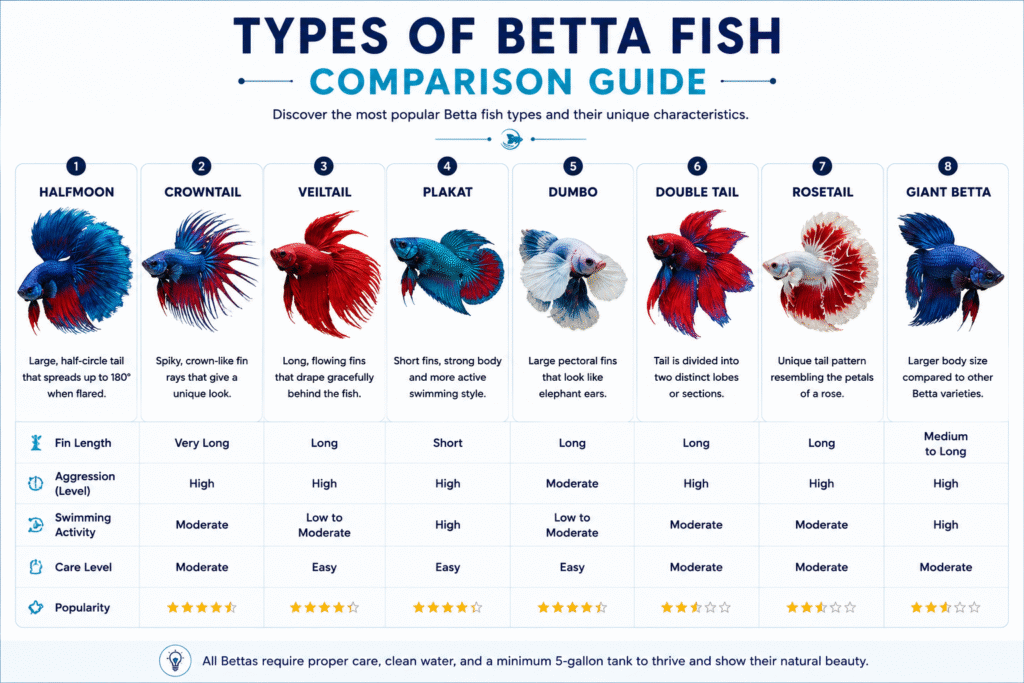
One of the biggest reasons Betta fish have become so popular is the incredible variety of colors, fin shapes, and tail types available today. Through decades of selective breeding, hobbyists have developed hundreds of unique Betta varieties, each with its own beauty and personality.
Although all domesticated Betta fish belong to the same species (Betta splendens), they are commonly classified according to their tail shape, fin style, and coloration. Understanding these different types can help you choose the Betta that best suits your aquarium and personal preference.
Let’s explore some of the most popular Betta fish varieties found in the aquarium hobby.
1. Halfmoon Betta
The Halfmoon Betta is one of the most sought-after Betta varieties. Its large caudal (tail) fin spreads into a perfect 180-degree semicircle when fully flared, creating a dramatic and elegant appearance.
Halfmoon Bettas are available in a wide range of colors, including red, blue, turquoise, white, black, and multicolored patterns. Because of their long, flowing fins, they should be kept in aquariums with gentle water flow to prevent fin damage and reduce swimming fatigue.
Best for: Aquarists who appreciate graceful, flowing fins.
2. Crowntail Betta
The Crowntail Betta is easily recognized by the spiky rays extending beyond the webbing of its fins, giving it a crown-like appearance.
Developed through selective breeding in Indonesia, Crowntails are energetic swimmers and are available in many vibrant colors. Their distinctive fin structure makes them one of the most recognizable Betta varieties.
Best for: Hobbyists looking for a unique and eye-catching Betta.
3. Veiltail Betta
The Veiltail Betta is the most commonly available variety in pet stores and is often recommended for beginners.
Its long tail gracefully flows downward like a veil, creating a beautiful appearance without requiring the premium price of some rarer varieties. Veiltails are hardy, easy to care for, and available in numerous color combinations.
Best for: First-time Betta owners.
4. Plakat Betta
Unlike long-finned varieties, the Plakat Betta has short, compact fins that closely resemble those of wild Betta fish.
These Bettas are powerful swimmers, highly active, and generally less prone to fin injuries. Their athletic build and energetic behavior make them a favorite among experienced aquarists.
Best for: Owners who prefer active fish with a more natural appearance.
5. Double Tail Betta
The Double Tail Betta has a unique genetic trait that produces two distinct tail lobes rather than one. This unusual feature gives the fish a fuller and more symmetrical appearance.
Because of their body structure, Double Tail Bettas may be more susceptible to spinal deformities than other varieties. Choosing a healthy fish from a reputable breeder is especially important.
Best for: Collectors seeking unusual Betta varieties.
6. Delta and Super Delta Betta
Delta Bettas have broad tails that spread outward in the shape of the Greek letter delta (Δ). Super Delta Bettas have an even wider tail spread, approaching—but not quite reaching—the perfect 180-degree angle of a Halfmoon.
These varieties combine elegance with improved swimming ability compared to some long-finned Bettas.
7. Rosetail and Feathertail Betta
Rosetail and Feathertail Bettas are highly ornamental varieties with heavily branched fins that create a ruffled, flower-like appearance.
While visually stunning, their oversized fins require extra care because they are more vulnerable to tearing and fin rot.
8. Dumbo (Elephant Ear) Betta
The Dumbo Betta stands out because of its oversized pectoral fins, which resemble elephant ears. As these fins move, the fish appears to “wave” through the water, creating a graceful swimming motion.
Dumbo Bettas are available in both short-finned and long-finned forms and come in many attractive colors.
9. Giant Betta
The Giant Betta is a selectively bred variety that can grow up to twice the size of a standard Betta fish.
Because of their larger size, Giant Bettas require bigger aquariums, stronger filtration, and additional swimming space to stay healthy.
Choosing the Right Betta Fish
Selecting the right Betta depends on your experience level, aquarium setup, and personal preference.
If you’re new to fishkeeping, hardy varieties such as Veiltail or Plakat Bettas are excellent choices because they are active, adaptable, and relatively easy to care for. More delicate varieties, including Halfmoon, Rosetail, and Feathertail Bettas, require extra attention to water quality and fin health.
No matter which variety you choose, always look for a Betta that has bright coloration, intact fins, clear eyes, smooth swimming movements, and an active interest in its surroundings. Avoid fish that appear lethargic, have clamped fins, visible injuries, or signs of disease.
Betta Fish Appearance and Physical Characteristics
Betta fish are admired worldwide for their striking appearance, vibrant colors, and graceful fins. While every Betta has its own unique personality, their physical characteristics are equally fascinating and make them one of the most recognizable freshwater fish in the aquarium hobby.
1. Colors
Bettas come in an extraordinary range of colors: red, blue, turquoise, orange, yellow, white, black, and combinations of all of them. Color patterns have their own vocabulary in the hobby — “cellophane” for translucent fish, “marble” for fish with patches of color that can actually shift over the fish’s lifetime, “butterfly” for fish with a solid body color and white-tipped fins. No two bettas are ever identical.
2. Tail Types
Tail shape is the single biggest factor in how a betta looks, and it’s significant enough that we cover it in its own section below. Broadly, tail types range from the short, rounded fins of a plakat to the dramatic 180-degree spread of a halfmoon.
3. Body Shape
A healthy betta has a torpedo-shaped body, slightly compressed from side to side, with a pointed head and an upturned mouth suited to feeding at or near the water’s surface. A bloated or pinecone-shaped body is a warning sign of illness, not a normal variation.
4. Male vs. Female Betta Fish
Males are the showier sex — longer fins, more saturated colors, and a more pronounced beard (the membrane under the gills, which flares during display). Females are typically smaller, with shorter fins and more muted coloring, though female bettas sold today can still be quite colorful thanks to selective breeding. Females also have a visible ovipositor, a small white dot near the belly, which males lack.
5. Size
Most bettas reach 2.5 to 3 inches in body length, not counting the fins. Long-finned varieties can look considerably larger because of their flowing tails, but the actual body size is fairly consistent across types.
Betta Fish Behavior and Personality
Bettas are far more expressive than most beginners expect, and understanding their behavior helps you tell the difference between normal quirks and signs something’s wrong.
- Flaring is when a betta spreads its gill covers, fins, and beard to look larger — typically in response to a perceived rival, like another betta, a mirror, or sometimes its own reflection in glass. It’s a normal display behavior, not a sign of distress, though frequent flaring can be stressful if it happens constantly. For a full breakdown of why bettas flare and what triggers it, see our dedicated flaring guide.
- Bubble nests are clusters of bubbles a male builds at the water’s surface, usually out of saliva-coated air bubbles. It’s instinctive breeding behavior — a male building a nest doesn’t necessarily mean he has a mate nearby, and a happy, healthy male betta may build nests regularly even alone.
- Sleeping habits: bettas do sleep, typically at night or when lights are off, often resting near the bottom or tucked against a plant or decoration. A motionless betta at night is usually just asleep, not sick.
- Jumping: bettas are surprisingly strong jumpers and can launch themselves out of an open tank, especially when startled. A secure lid isn’t optional — it’s a basic safety requirement.
- Aggression: territorial behavior is hardwired, especially toward other bettas. Males will almost always fight if housed together, and even female bettas can be aggressive toward each other or toward other species.
- Recognizing owners: bettas can learn to associate their owner with feeding time, often swimming to the front of the tank when you approach. This isn’t anthropomorphizing — it’s documented, trainable behavior.
- Curiosity: bettas will investigate new objects, follow your finger along the glass, and explore tank décor, especially when their environment is enriched with plants and hiding spots.
Betta Fish Lifespan: How Long Do Betta Fish Live?
One of the first questions many new fish keepers ask is, “How long do Betta fish live?” The answer depends largely on the care they receive throughout their lives.
On average, Betta fish live between 2 and 5 years in captivity. While some Bettas may only live for a couple of years due to poor care or health issues, others have been known to live well beyond five years when kept in excellent conditions.
Their lifespan is influenced by several factors, including water quality, diet, genetics, stress levels, and the overall aquarium environment. Although genetics cannot be changed, providing proper care can significantly improve both the quality and length of your Betta’s life.
Factors That Affect a Betta Fish’s Lifespan
1. Water Quality
Clean, stable water is one of the biggest factors in keeping a Betta healthy. Poor water conditions can expose fish to harmful toxins such as ammonia and nitrite, increasing stress and making them more vulnerable to disease.
Regular water changes, proper filtration, and routine water testing help create a safe environment where Bettas can thrive.
2. Proper Nutrition
A balanced, protein-rich diet supports healthy growth, vibrant coloration, and a strong immune system. High-quality Betta pellets, combined with occasional frozen or live foods, provide the nutrients needed for long-term health.
Overfeeding should also be avoided, as it can lead to obesity, digestive issues, and poor water quality.
3. Stable Water Temperature
Betta fish are tropical animals and prefer water temperatures between 78°F and 80°F (25.5°C–26.5°C). Sudden temperature fluctuations can weaken their immune system and increase the risk of illness.
Using a reliable aquarium heater helps maintain a stable environment throughout the year.
4. Stress-Free Environment
Stress has a significant impact on a Betta’s overall health. Overcrowded tanks, aggressive tank mates, strong water currents, and frequent environmental changes can all contribute to chronic stress.
Providing plenty of swimming space, hiding spots, and a peaceful aquarium allows your Betta to display natural behaviors while reducing anxiety.
How to Help Your Betta Fish Live Longer
Although no one can guarantee how long an individual Betta will live, following these simple practices gives your fish the best chance of reaching its full lifespan:
- Keep your Betta in an aquarium of at least 5 gallons.
- Maintain clean, well-filtered water.
- Use a heater to keep the temperature stable.
- Feed a balanced, high-quality diet.
- Avoid overfeeding.
- Perform regular water changes.
- Monitor your Betta daily for signs of illness or unusual behavior.
- Quarantine new fish before introducing them to a community aquarium.
Small, consistent habits often have a greater impact than expensive equipment.
Common Mistakes That Can Shorten a Betta’s Life
Many premature deaths are linked to avoidable mistakes rather than old age.
Some of the most common include:
- Keeping Bettas in tiny bowls.
- Poor water quality.
- Skipping regular maintenance.
- Feeding too much food.
- Housing incompatible tank mates.
- Ignoring early signs of illness.
- Allowing large temperature fluctuations.
By avoiding these common mistakes and providing consistent care, you can greatly improve your Betta’s chances of living a long, healthy life.
Quick Answer: With proper care, most Betta fish live 2–5 years, but excellent water quality, a nutritious diet, and a stress-free environment can help them enjoy a longer and healthier life.
Best Tank Mates for Betta Fish
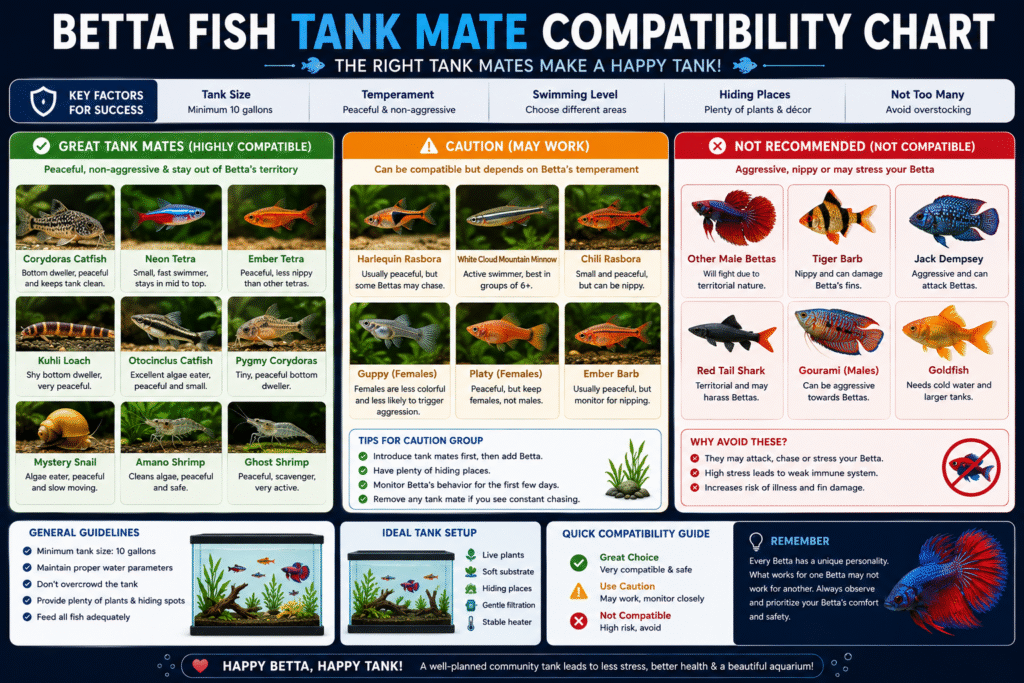
Although Betta fish are famous for their territorial nature, this doesn’t necessarily mean they must always live alone. With careful planning and the right aquarium setup, Bettas can coexist peacefully with certain tank mates.
The key is understanding your Betta’s personality and choosing companions that are peaceful, non-aggressive, and unlikely to compete for territory.
It’s also important to remember that every Betta has a unique temperament. While one Betta may peacefully share its aquarium, another may become aggressive toward the same species. Always observe your fish closely after introducing any new tank mates.
- Compatible Tank Mates for Betta Fish
Many peaceful freshwater species can live successfully alongside a Betta in a properly sized aquarium.
Some popular choices include:
- Corydoras Catfish
- Kuhli Loaches
- Harlequin Rasboras
- Ember Tetras
- Neon Tetras (in larger aquariums)
- Otocinclus Catfish
These species generally occupy different areas of the aquarium and are less likely to provoke territorial behavior.
A larger aquarium with plenty of plants and hiding places further increases the chances of successful cohabitation.
- Can Betta Fish Live with Shrimp?
Yes, but with caution.
Some Bettas completely ignore shrimp, while others instinctively see them as food. Larger shrimp species, such as Amano Shrimp, usually have a better chance of living peacefully with a Betta than smaller shrimp varieties.
Providing dense plants, moss, and hiding places can improve the survival of shrimp in a Betta aquarium.
- Can Betta Fish Live with Snails?
Snails are among the safest companions for most Betta fish.
Popular options include:
- Nerite Snails
- Mystery Snails
- Malaysian Trumpet Snails
Most Bettas pay little attention to snails, making them excellent additions that also help clean algae and leftover food from the aquarium.
- Fish to Avoid
Not every fish makes a suitable companion for a Betta.
Avoid keeping Bettas with:
- Other male Bettas
- Aggressive Cichlids
- Tiger Barbs
- Fin-nipping fish
- Large predatory species
- Fish with long, flowing fins that may trigger aggression
Even peaceful-looking fish can become targets if they resemble another male Betta.
- Can Two Betta Fish Live Together?
Two male Betta fish should never be housed together in the same aquarium. Their territorial instincts almost always lead to fighting, which can result in severe injuries or death.
Female Bettas can sometimes be kept together in carefully managed groups known as a sorority, but this requires a large, well-planted aquarium and close monitoring. Because managing a sorority can be challenging, it is generally not recommended for beginners.
- Tips for a Peaceful Community Aquarium
If you plan to keep your Betta with other fish, these tips can improve your chances of success:
- Choose a tank of at least 15–20 gallons for a community setup.
- Add plenty of live plants and hiding spots.
- Avoid overcrowding the aquarium.
- Introduce tank mates carefully and monitor their interactions.
- Be prepared to separate fish if aggression develops.
Remember that every Betta is an individual. Compatibility depends not only on the species you choose but also on your Betta’s personality.
Quick Answer: Betta fish can live with certain peaceful species, shrimp, and snails in a well-maintained aquarium. However, they should never be housed with other male Bettas or aggressive, fin-nipping fish.
How to Set Up the Perfect Betta Fish Tank
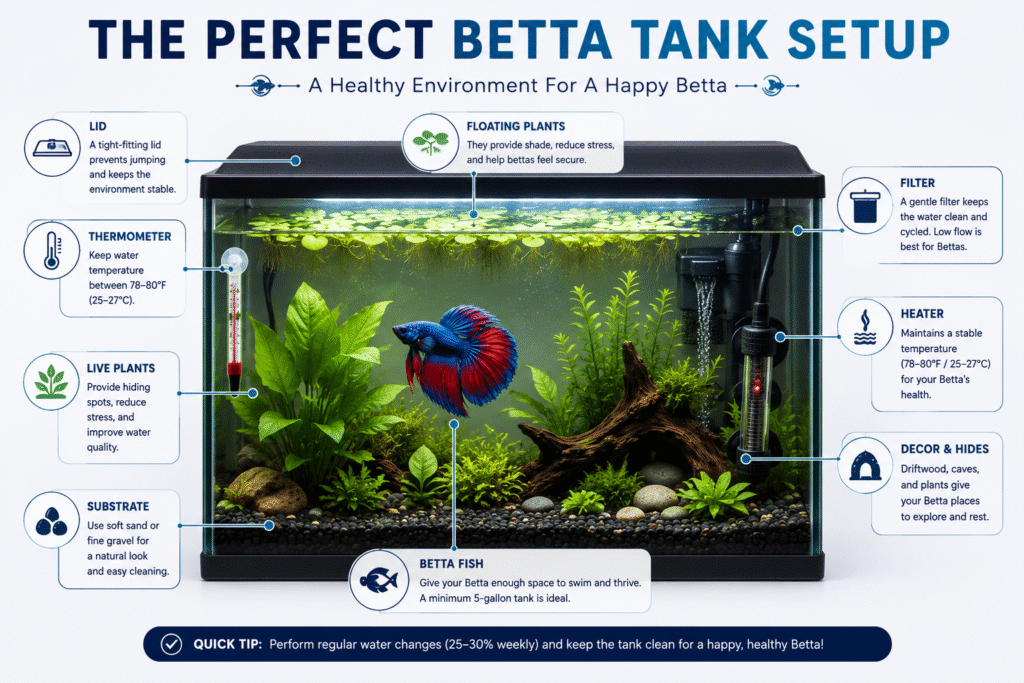
Creating the right aquarium environment is one of the most important factors in keeping a Betta fish healthy and happy. Although Betta fish are often marketed as pets that can survive in small bowls, they thrive in properly maintained aquariums that provide enough space, stable water conditions, and plenty of places to explore.
A well-designed Betta tank not only enhances the fish’s vibrant colors and natural behaviors but also reduces stress, lowers the risk of disease, and can significantly increase its lifespan. By recreating conditions similar to their natural habitat, you give your Betta the best chance to live a long and healthy life.
Let’s look at the essential elements of an ideal Betta fish aquarium.
- Choosing the Right Tank Size
One of the biggest misconceptions about Betta fish is that they can live comfortably in tiny bowls or small containers. While Bettas can survive in limited spaces because of their labyrinth organ, survival is very different from thriving.
For long-term health, a minimum aquarium size of 5 gallons (19 liters) is recommended. A larger tank offers several important advantages, including better water stability, more swimming space, easier maintenance, and additional room for plants and decorations.
Larger aquariums also dilute harmful waste more effectively, making it easier to maintain safe water parameters.
- Install a Quality Filter
A good filtration system helps remove waste, uneaten food, and harmful toxins while supporting beneficial bacteria that keep the aquarium biologically balanced.
Because Betta fish naturally live in calm waters, choose a filter with gentle water flow. Strong currents can make swimming difficult, damage their delicate fins, and cause unnecessary stress.
Sponge filters and adjustable-flow filters are popular choices for Betta aquariums because they provide effective filtration without creating excessive water movement.
- Use a Reliable Aquarium Heater
Betta fish are tropical fish that require warm, stable water throughout the year.
The ideal water temperature is 78–80°F (25.5–26.5°C). Temperatures below this range can slow their metabolism, weaken their immune system, and increase the risk of illness.
Using an adjustable aquarium heater along with a thermometer helps maintain a consistent temperature and prevents sudden fluctuations that may stress your fish.
- Add Live or Artificial Plants
Plants are much more than decoration—they help create a comfortable and enriching environment for your Betta.
Aquatic plants provide hiding places, resting spots, and visual barriers that reduce stress. Many Betta fish enjoy resting on broad leaves near the surface, where they can easily access air when needed.
Popular beginner-friendly plants include Java Fern, Anubias, Java Moss, Amazon Sword, and floating plants such as Frogbit or Salvinia. If you choose artificial plants, select soft silk varieties instead of plastic ones to avoid tearing delicate fins.
- Choose Safe Decorations
Decorations make the aquarium more interesting while providing shelter and reducing boredom.
Before adding any decoration, check that it has smooth edges and no sharp surfaces that could damage your Betta’s fins. Aquarium caves, driftwood, rocks with smooth surfaces, and ceramic shelters are excellent choices.
Always rinse new decorations thoroughly before placing them in the aquarium.
- Select the Right Substrate
The substrate forms the base of your aquarium and contributes to both appearance and plant growth.
Fine gravel or aquarium sand are excellent options for Betta tanks. Dark-colored substrates often make Betta fish colors appear even more vibrant while creating a more natural-looking environment.
If you plan to keep live plants, consider using a nutrient-rich substrate designed specifically for planted aquariums.
- Provide Proper Lighting
Lighting supports plant growth, enhances the appearance of your aquarium, and helps maintain your Betta’s natural day-and-night cycle.
Aim for 8–10 hours of light per day. Excessive lighting can encourage algae growth, while too little light may affect live plants.
Using a timer is a simple way to maintain a consistent lighting schedule.
- Leave Space Above the Water
Unlike many other freshwater fish, Bettas regularly swim to the surface to breathe atmospheric oxygen using their labyrinth organ.
For this reason, avoid filling the aquarium completely to the top. Leave a small gap between the water surface and the lid so your Betta can breathe comfortably.
A secure lid is also highly recommended because Bettas are excellent jumpers and may leap out of uncovered aquariums.
- Cycle the Aquarium Before Adding Your Betta
One of the most important—but often overlooked—steps in aquarium setup is cycling the tank.
Cycling allows beneficial bacteria to establish themselves in the filter and substrate. These bacteria convert toxic ammonia from fish waste into less harmful compounds, creating a safer environment for your Betta.
Adding a fish to an uncycled aquarium can expose it to dangerous ammonia and nitrite levels, leading to stress, illness, or even death.
If you’re setting up your first aquarium, take the time to complete the nitrogen cycle before introducing your Betta. It’s one of the best investments you can make in your fish’s long-term health.
Pro Tip: A properly set-up aquarium doesn’t just make your Betta look beautiful—it also reduces maintenance, prevents many common diseases, and creates a healthier environment where your fish can display its natural behaviors.
Ideal Water Parameters for Betta Fish
Water quality is where most beginner bettas run into trouble, even in an otherwise well-set-up tank. It’s also the least visible part of betta care — a tank can look perfectly clean and still be quietly poisoning its occupant, which is why testing matters more than appearances.
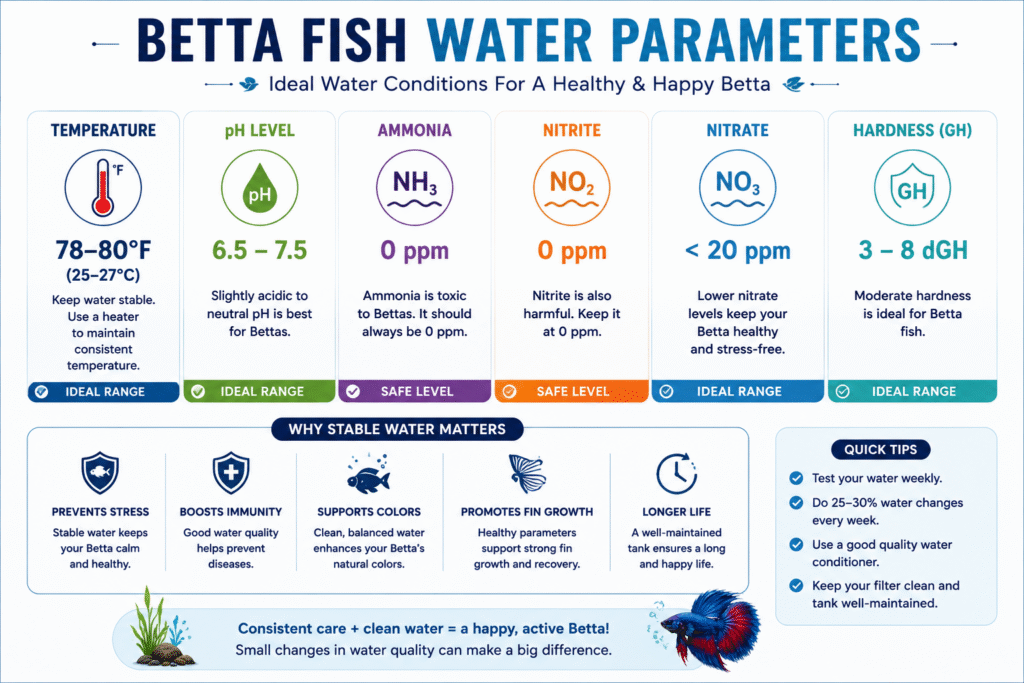
- pH: bettas tolerate a range, but 6.5–7.5 is ideal, and most tap water already falls somewhere in or near that window. Sudden pH swings are more dangerous than a stable pH slightly outside the ideal range, so avoid chasing a “perfect” number with chemical additives — a betta that’s adapted to a stable pH of 7.8 is generally better off than one bounced between 6.8 and 7.5 by inconsistent dosing.
- Ammonia: produced by fish waste, gill excretion, and uneaten food breaking down, ammonia is toxic even in small concentrations and should always read zero in a properly cycled, established tank. Rising ammonia is usually the first sign something’s wrong — an uncycled tank, overfeeding, overcrowding, or overdue maintenance — and it’s also one of the more reversible problems if caught early through a partial water change and a hard look at feeding habits.
- Nitrite: a byproduct of ammonia breakdown by the first stage of beneficial bacteria, nitrite is also highly toxic and should likewise read zero once your tank’s nitrogen cycle is complete. A nitrite spike in an otherwise established tank often points to a recent disruption — a filter that was cleaned too aggressively (washing away the bacterial colony), a sudden increase in bioload, or medication that disrupted the bacterial balance.
- Nitrate: the end product of the nitrogen cycle, far less toxic than ammonia or nitrite but still harmful to bettas in high concentrations over time, contributing to stress, weakened immunity, and stunted growth. Regular water changes are the main tool for keeping nitrate low, since it has no further biological breakdown step in a typical home aquarium — it simply accumulates until it’s diluted out.
- Water changes: a weekly change of roughly 25–30% of tank volume is a solid baseline for a 5-gallon tank, adjusted upward if your test results show nitrate climbing faster than that, or downward slightly in a heavily planted tank where live plants are absorbing more waste. Always dechlorinate tap water with a water conditioner before adding it, since chlorine and chloramine are harmful to fish gills and lethal to the beneficial bacteria your entire cycle depends on — skipping this step can undo weeks of cycling in a single water change.
A simple liquid test kit, rather than test strips, gives far more reliable and precise readings and is one of the best investments a beginner can make — it turns water quality from a guessing game into something you can actually track and respond to before problems become visible in the fish itself.
What Do Betta Fish Eat?
Providing a nutritious and balanced diet is one of the most important aspects of Betta fish care. Like all living creatures, Betta fish need the right combination of nutrients to stay healthy, maintain their vibrant colors, support their immune system, and live a long life.
In the wild, Betta fish are primarily carnivorous. Their natural diet consists mainly of insect larvae, mosquito larvae, tiny crustaceans, worms, and other small aquatic invertebrates. This means they require a protein-rich diet rather than plant-based foods.
In captivity, the best diet for a Betta fish combines high-quality commercial Betta pellets with occasional treats such as frozen or live foods. A varied diet helps ensure they receive all the nutrients needed for healthy growth and overall well-being.
- Best Foods for Betta Fish
Although Bettas are not particularly fussy eaters, choosing high-quality food makes a significant difference to their health.
Some of the best food options include:
- High-quality Betta pellets
- Frozen bloodworms
- Brine shrimp
- Daphnia
- Mosquito larvae
- Freeze-dried treats (occasionally)
Look for Betta-specific pellets that list fish meal or whole fish as one of the primary ingredients. Foods with excessive fillers should be avoided whenever possible.
Offering a variety of foods throughout the week provides a more balanced diet and helps prevent nutritional deficiencies.

- Foods to Avoid
Not every food sold for aquarium fish is suitable for Bettas.
Avoid feeding your Betta:
- Bread
- Rice
- Crackers
- Human snacks
- Chocolate
- Dairy products
- Seasoned foods
- Large pieces of vegetables
- Overly fatty foods
These foods offer little nutritional value and may cause digestive problems or poor water quality.
How Often Should You Feed a Betta Fish?
Feeding your Betta the correct amount is just as important as choosing the right food. Overfeeding is one of the most common mistakes made by beginner fish keepers and can lead to obesity, constipation, swim bladder problems, and poor water quality.
As a general guideline, adult Betta fish should be fed once or twice a day in small portions.
Only provide as much food as your Betta can consume within 1–2 minutes. Remove any uneaten food promptly to prevent it from decomposing and affecting the water quality.
Many experienced aquarists also recommend having one fasting day each week. This allows the digestive system to rest and may help reduce the risk of constipation and bloating.
Signs of a Healthy Diet
A well-fed Betta fish will usually display:
- Bright, vibrant colors
- Active swimming behavior
- Healthy appetite
- Smooth body shape
- Strong fin growth
- Consistent energy levels
If your Betta suddenly refuses food or loses weight, it may indicate stress, illness, poor water quality, or unsuitable food.
Beginner Feeding Tips
If you’re new to Betta fish, these simple habits can make a big difference:
- Feed small portions rather than large meals.
- Choose high-quality Betta pellets as the main diet.
- Offer frozen or live foods as occasional treats.
- Avoid overfeeding.
- Remove uneaten food after feeding.
- Observe your Betta during every meal for changes in appetite or behavior.
Want to know exactly what to feed your Betta and how much? Read our complete Betta Fish Food Guide for detailed feeding schedules, recommended foods, and expert tips.
Common Betta Fish Diseases
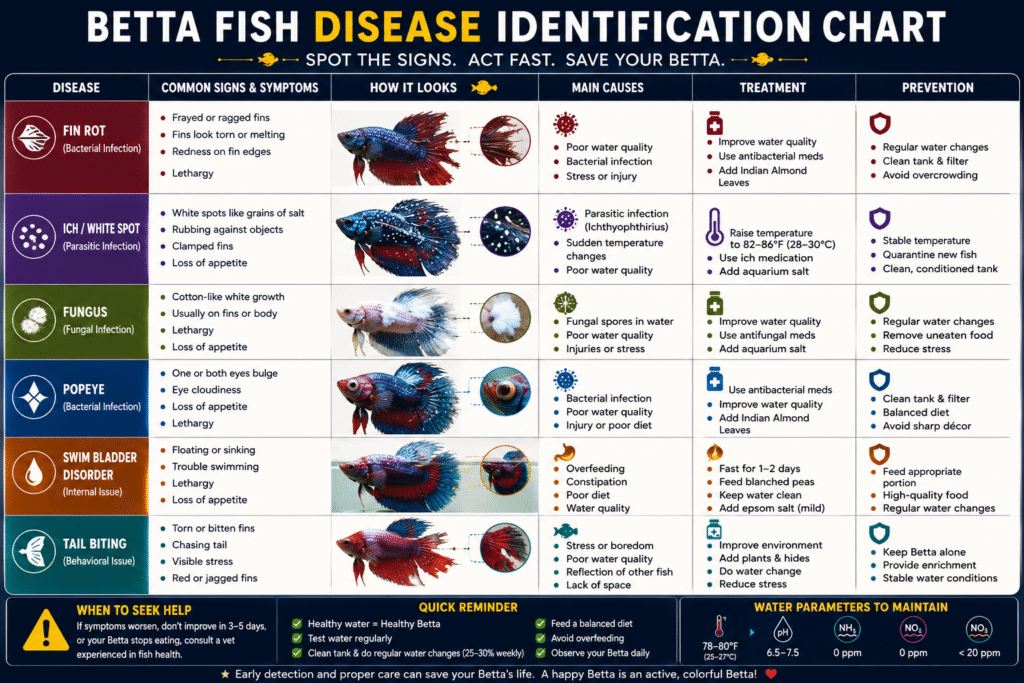
Even with excellent care, Betta fish can occasionally develop health problems. The good news is that most common diseases can be successfully treated when detected early.
The best way to keep your Betta healthy is through prevention. Maintaining clean water, providing a balanced diet, avoiding sudden temperature changes, and reducing stress are the most effective ways to minimize the risk of disease.
Here are some of the most common health issues that affect Betta fish.
- Fin Rot
Fin rot is one of the most frequently seen illnesses in Betta fish. It is usually caused by poor water quality, bacterial infections, stress, or injuries to the fins.
Signs include:
- Frayed or torn fins
- Black or white edges on the fins
- Gradual shortening of the fins
- Reduced activity
Early treatment and improved water quality often lead to a full recovery.
- Ich (White Spot Disease)
Ich is a highly contagious parasitic disease recognized by the appearance of tiny white spots on the fish’s body and fins.
Symptoms include:
- White spots
- Flashing or rubbing against objects
- Rapid breathing
- Loss of appetite
Prompt treatment and careful monitoring are essential to prevent the disease from spreading.
- Swim Bladder Disorder
A Betta with swim bladder problems may struggle to maintain balance or swim normally.
Common signs include:
- Floating uncontrollably
- Sinking to the bottom
- Swimming sideways
- Difficulty maintaining position in the water
Overfeeding, constipation, injury, or infection are common causes.
- Fungal Infections
Fungal infections often appear as cotton-like white growths on the body, mouth, or fins.
These infections usually develop after injuries or prolonged exposure to poor water conditions.
- Velvet Disease
Velvet is caused by microscopic parasites and appears as a fine golden or rust-colored dust on the fish’s body.
Symptoms may include:
- Clamped fins
- Lethargy
- Loss of appetite
- Scratching against decorations
- Difficulty breathing
Early diagnosis greatly improves the chances of successful treatment.
Prevention Is Better Than Treatment
The healthiest Betta fish are usually those living in stable, well-maintained aquariums.
To reduce the risk of disease:
- Perform regular water changes.
- Test water parameters regularly.
- Feed a balanced diet.
- Avoid overcrowding the aquarium.
- Quarantine new fish before introducing them.
- Observe your Betta daily for changes in behavior or appearance.
Need help identifying symptoms and treatments? Read our detailed Common Betta Diseases and Treatments guide for diagnosis, medication options, and prevention tips.
Betta Fish Breeding
Breeding Betta fish can be one of the most rewarding experiences in the aquarium hobby, but it also requires careful planning, patience, and a thorough understanding of the species. While the colorful courtship rituals and bubble nests may look fascinating, successful breeding involves much more than simply placing a male and female together.
If you’re new to fishkeeping, it’s generally best to gain experience caring for Bettas before attempting to breed them. Healthy adult fish, stable water conditions, and a dedicated breeding aquarium are all essential for success.
- Understanding Betta Fish Courtship
When a male Betta is ready to breed, one of the first signs is the construction of a bubble nest. Using tiny bubbles coated with saliva, the male creates a floating nest near the water’s surface, often beneath floating plants or in a quiet corner of the aquarium.
The bubble nest serves as a safe nursery where fertilized eggs will be protected until they hatch.
A healthy female Betta that is ready to breed usually develops a noticeably rounded abdomen filled with eggs. Many females also display distinct vertical stripes along their bodies, which indicate breeding readiness rather than stress.
Courtship can take several hours or even days. During this period, the male may flare his fins, swim around the female, and guide her toward the bubble nest.
- The Spawning Process
Once the female accepts the male, the pair begins a unique spawning ritual.
The male gently wraps his body around the female in what is known as the breeding embrace. During each embrace, the female releases a small number of eggs while the male fertilizes them externally.
The eggs slowly sink toward the bottom of the aquarium. The male carefully collects each egg in his mouth and places it inside the bubble nest. This process may be repeated many times until hundreds of eggs have been laid.
Although the breeding ritual appears peaceful, it can be physically demanding for both fish. Minor chasing and fin damage are common, but excessive aggression should never be ignored.
- Caring for the Eggs
Once spawning is complete, the female should be removed from the breeding tank. In nature, the male takes full responsibility for protecting the eggs, while the female leaves the nesting area.
For the next 24 to 48 hours, the male continuously guards the bubble nest, replacing fallen eggs and repairing damaged bubbles. During this period, he rarely eats and remains focused on protecting his future offspring.
The eggs usually hatch within one to two days, depending on water temperature.
- Raising Betta Fry
After hatching, the tiny fry remain attached to the bubble nest while they absorb nutrients from their yolk sacs.
A few days later, the fry become free-swimming. At this stage, the male should also be removed from the aquarium, as his parental duties have ended and he may begin viewing the fry as food.
Young Bettas require frequent feedings of appropriately sized live foods, such as infusoria during their first days, followed by newly hatched brine shrimp and other nutritious foods as they grow.
Maintaining excellent water quality is critical throughout this stage because fry are highly sensitive to sudden changes in water conditions.
Is Breeding Betta Fish Right for Beginners?
Although breeding Bettas is fascinating, it is not recommended as a beginner project.
A successful breeding setup requires additional aquariums, specialized foods for fry, time for daily maintenance, and a long-term plan for separating young males as they mature. A single breeding pair can produce hundreds of fry, each requiring proper care and space.
For most new aquarists, learning the fundamentals of Betta care before attempting breeding is the best path to long-term success.
Planning to breed Betta fish? Read our complete Betta Fish Breeding Guide for a step-by-step walkthrough, breeding tank setup, fry care, and common mistakes to avoid.
Common Mistakes New Betta Owners Should Avoid
Many health problems experienced by Betta fish are not caused by disease but by simple care mistakes that are easy to prevent. Learning about these common errors before bringing home a Betta can save both you and your fish from unnecessary stress.
- Keeping Bettas in Tiny Bowls
One of the oldest myths about Betta fish is that they are perfectly happy living in small bowls or decorative vases.
While Bettas can survive in these conditions for a period of time, they cannot truly thrive. Limited swimming space, unstable water quality, and rapid temperature changes often lead to chronic stress and a shorter lifespan.
A properly filtered aquarium of at least 5 gallons (19 liters) provides a far healthier environment.
- Overfeeding
Betta fish have surprisingly small stomachs—roughly about the size of one of their eyes.
Offering too much food can quickly lead to obesity, constipation, poor water quality, and swim bladder problems.
Feeding small portions once or twice a day is usually sufficient for a healthy adult Betta.
- Skipping Water Changes
Crystal-clear water does not always mean clean water.
Invisible toxins such as ammonia and nitrate can build up over time, even if the aquarium looks spotless.
Regular partial water changes help remove waste, maintain stable water chemistry, and keep your Betta healthy.
- Forgetting the Heater
Because Betta fish are tropical animals, they depend on warm, stable temperatures throughout the year.
Cold water slows their metabolism, weakens their immune system, and increases the likelihood of disease.
Using a reliable heater is one of the best investments you can make for your Betta’s long-term health.
- Housing Two Male Bettas Together
Male Bettas are naturally territorial and should never share the same aquarium.
Placing two males together almost always leads to aggressive encounters, severe injuries, or even death.
If you want a peaceful community aquarium, choose compatible tank mates only after careful research.
- Ignoring Changes in Behavior
Your Betta often gives early warning signs when something is wrong.
A healthy Betta is usually alert, curious, and interested in food. If your fish suddenly becomes inactive, refuses meals, clamps its fins, hides constantly, or struggles to swim, take time to investigate the cause rather than hoping the problem will disappear on its own.
Daily observation is one of the simplest and most effective ways to keep your Betta healthy.
- Buying a Betta Without Preparation
Many people purchase a Betta on impulse because of its beautiful colors, only to discover later that they lack the proper equipment or knowledge to care for it.
Setting up and cycling an aquarium before bringing your fish home gives your Betta a much better start and helps avoid many common beginner problems.
A Final Thought Before the FAQ Section
The happiest Betta fish aren’t necessarily the ones living in the most expensive aquariums—they’re the ones whose owners understand their needs and provide consistent care. Clean water, proper nutrition, a peaceful environment, and regular observation will do far more for your Betta’s health than expensive decorations or gadgets.
Frequently Asked Questions About Betta Fish
1. How long do Betta fish live?
With proper care, Betta fish typically live between 2 and 5 years. A healthy diet, clean water, stable temperatures, and a stress-free environment all play an important role in helping them reach their full lifespan.
2. Can Betta fish live in a bowl?
Although Betta fish can survive in small bowls for a limited time, they do not thrive in them. Bowls are difficult to heat, filter, and maintain, which often leads to poor water quality and unnecessary stress. A properly filtered aquarium of at least 5 gallons is a much healthier choice.
3. Do Betta fish need a heater?
Yes. Betta fish are tropical fish that require warm water throughout the year. An aquarium heater helps maintain a stable temperature between 78–80°F (25.5–26.5°C), which supports healthy growth, digestion, and immune function.
4. How often should I feed my Betta fish?
Most adult Betta fish should be fed once or twice a day in small portions. Feed only what your fish can consume within one to two minutes, and remove any uneaten food to help maintain good water quality.
5. Why is my Betta fish not eating?
Loss of appetite can occur for several reasons, including stress, poor water quality, sudden temperature changes, illness, or simply adjusting to a new environment. If your Betta refuses food for more than a few days or shows other unusual symptoms, check the water parameters and observe the fish closely.
6. Can Betta fish live with other fish?
Yes, but only with carefully selected tank mates. Peaceful species that do not nip fins or compete aggressively for territory are generally the best companions. Two male Bettas should never be kept together in the same aquarium.
7. Why is my Betta fish lying at the bottom of the tank?
Betta fish sometimes rest near the bottom of the aquarium, especially while sleeping. However, if your fish remains inactive for long periods, struggles to swim, or refuses food, it could indicate stress, illness, or poor water conditions.
8. Why does my Betta fish flare its fins?
Flaring is a natural behavior used to defend territory, communicate with rivals, or impress a potential mate. Occasional flaring is normal, but constant flaring caused by reflections or stress should be addressed.
9. How often should I change the water in a Betta tank?
The frequency depends on your tank size, filtration, and stocking level. In most home aquariums, regular partial water changes help maintain stable water quality and remove accumulated waste. Always avoid changing all of the water at once unless necessary.
10. Are Betta fish good for beginners?
Yes. Betta fish are often recommended for beginners because they are hardy, beautiful, and relatively easy to care for. With the proper aquarium setup and regular maintenance, they can make excellent first pets.
11. Can betta fish live alone?
Yes, and in most cases they should. Bettas are territorial and don’t need tankmates to be content; many owners successfully house them alone in a well-decorated tank.
12. Do betta fish sleep? Yes, typically at night, often resting near the bottom or tucked against a plant or decoration.
13. Can betta fish recognize their owners?
Yes — many bettas learn to associate their owner with feeding and will swim toward the front of the tank when approached.
14. Can two female betta fish live together?
Sometimes, in a larger tank with plenty of hiding spots — this is called a “sorority” — but it requires careful monitoring and isn’t recommended for beginners.
15. What size tank does a betta fish need?
5 gallons is the realistic minimum; larger tanks make water quality and temperature far easier to keep stable.
16. Do betta fish need a filter?
Yes, though the flow should be gentle. Filtration helps manage waste and supports the beneficial bacteria that keep ammonia and nitrite at safe levels.
17. What do betta fish eat?
Bettas are carnivores and do best on high-quality betta pellets, supplemented with occasional treats like bloodworms or brine shrimp.
18. How big do betta fish get?
Most reach 2.5 to 3 inches in body length, with long-finned varieties appearing larger due to their fins.
19. Why is my betta fish’s color fading?
Color loss can result from stress, poor water quality, illness, or in some cases natural aging — marble-patterned bettas in particular can shift color throughout their lives.
20. Can betta fish jump out of the tank?
Yes, bettas are strong jumpers, especially when startled, which is why a secure lid is essential.
21. How do I know if my betta fish is happy?
Signs of a content betta include active swimming, healthy appetite, vivid color, and curiosity toward you or new objects in the tank, as opposed to clamped fins, lethargy, or hiding.
Conclusion
Betta fish are far more than just colorful aquarium pets. They are intelligent, curious, and fascinating creatures that can develop unique personalities when given the right care. Whether you’re setting up your very first aquarium or looking to improve your fish-keeping knowledge, understanding your Betta’s needs is the key to helping it live a healthy and fulfilling life.
Throughout this guide, we’ve explored everything from their natural habitat and behavior to tank setup, feeding, water quality, common diseases, and breeding. While Betta fish are considered beginner-friendly, they still depend on responsible care, a clean environment, proper nutrition, and regular observation to thrive.
Remember, successful Betta keeping isn’t about buying the most expensive equipment—it’s about providing a stable, stress-free environment and paying attention to your fish every day. Small habits, such as maintaining water quality, feeding the right amount, and recognizing early signs of illness, can make a significant difference in your Betta’s health and lifespan.
As your experience grows, you’ll begin to notice your Betta’s unique personality, daily routines, and behaviors, making fishkeeping an even more rewarding hobby.
At Fishifi, our goal is to help you become a confident and knowledgeable fish keeper. Be sure to explore our other Betta care guides, where we cover topics like feeding, tank maintenance, diseases, breeding, and much more in greater detail.
Thank you for reading, and we hope your Betta enjoys a long, healthy, and happy life.